 Skip to main content
Industry insights | December 18, 2025 | By Owen Roberts
A rumour runs through Jesse Sheather’s family, that legendary Canadian musician, the late Stompin’ Tom Connors, acquired nuggets for his iconic country hit “Tillsonburg” through hard work on Jesse’s uncle’s tobacco farm nearby.
Is it true?
The Sheathers’ aren’t sure. But it’s definitely possible.
In the song’s era, the late 1960s and early 1970s, southwestern Ontario tobacco farms offered tonnes of work to Canadians like Stompin’ Tom. In return, those workers helped farmers get tough jobs done.
And now, some 60 years later, it turns out the apple hasn’t fallen far from the tree.
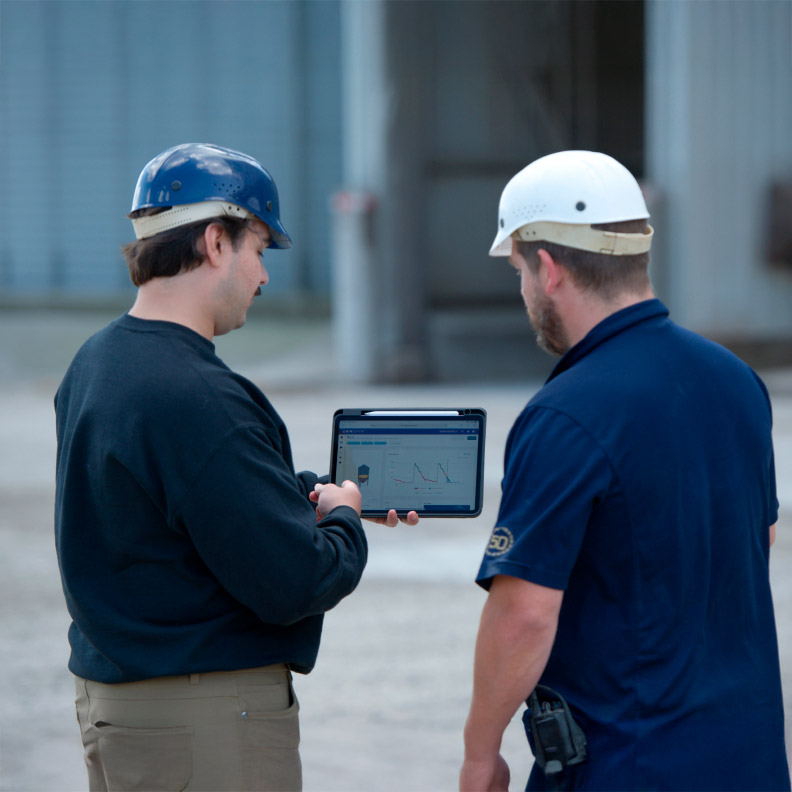
Jesse, product manager for BinSentry, believes the company embodies the same fundamental principles and traditions that are core to his family. BinSentry prides itself in having the most advanced artificial intelligence (AI) and monitoring hardware in the feed grain sector. And although AI is the epitome of hi-tech, Jesse notes that it’s people who are behind BinSentry’s technology — people who created and manage the company’s platforms and products, and people who use them at feed mills.
That foundational belief is reflected in the BinSentry product development team’s credo: We help real people do hard work to feed the world.
“The feed grain industry is working hard to manage inventories, and its success underpins food production throughout the value chain,” Jesse says. “Our people and our products are helping the industry succeed.”
Jesse believes success starts from the ground up – literally. He knows the importance of, in his words, “going where the customer lives.” That means being on the customer’s home turf, to truly understand challenges and opportunities before them…like trying to estimate inventory levels while hanging off the side of a massive grain bin, a key element to efficient management.
So, it’s not unusual to see him climbing ladders to the top of a customer’s 140-foot grain bins, peering inside to understand the inventory status quo, then scrambling down to work out product solutions with the company’s key AI-driven technology, ProSense HD.
“I like having the same experience as our customers,” Jesse says. “I have to climb bins to see what they see, so I can empathize with them, answer their questions, and explain how our products can help them never have to climb a bin again to measure inventory. We’re teaching AI to learn about inventory management, so later it can help us to do things that humans struggle with.”
Empathy, along with leadership and strategic thinking, is a product manager’s top traits…and when you’re 100-plus feet in the air on the top of a grain bin in zero-degree weather, you can definitely empathize with a customer’s challenges.
Solving problems is familiar territory for Jesse. As a youngster growing up in Elgin County, he loved rebuilding cars and working on building projects with his dad Jeff (the duo actually dug the foundation of the family home).
At the same time, Jesse was developing an interest in computer technology. At the time, it was an emerging field, and curious kids his age wanted to be part of it. He helped his mom, Donna, a university professor, manage her online platforms. And from that background, Jesse would go on earn a dual major business and computer science degree from the University of Windsor, then go on to join the workforce as a budding technology designer and leader.
Working with technology and people, as he’d done with his family, came together with BinSentry.
“I can speak the language of agriculture and I understand technology,” Jesse says. “It all came together with BinSentry.”
When he’s not climbing grain bins, Jesse continues exercising his love of cars and restoration…but not classic hot rods, like most other people. Instead, he’s now putting the finishing touches on a 1971 Vauxhall Firenza, a rarity in North America that never fails to draw the eyes of collectors and the just plain curious.
And most lately, he’s expressed his interest in cars by writing a series of novels, the first of which is called Twin Roads: Running. Set on the twisting roads of British Columbia, readers follow the angst and coming of age of a young driver – Jesse’s alter ego, perhaps? — in a restored, hand-me-down Ford Mustang, navigating slick hairpin turns and snowy winter nights.
Not surprising, for someone who eagerly looks forward to the next time he scales a 10-story grain bin then uses AI to figure out how to manage the inventory inside.
Owen Roberts is a past-president of the International Forum for Agricultural Journalism.