 Skip to main content
AI in ag | November 24, 2026 | BinSentry
A wave of applied artificial intelligence research reached livestock and feed management in mid-November. Researchers with the National Animal Nutrition Program's Feed Management Committee described a new machine-learning tool funded by the USDA Natural Resources Conservation Service that scores the risk of losing feed quantity or nutritional value across harvest, storage, handling, mixing, delivery and feed-out. In the same week, a North Carolina State University team detailed an artificial intelligence sensing project to analyze raw feed ingredients right before mixing, while Oklahoma State University Extension released Cowculator v2.0 and noted it is testing an artificial intelligence ration tool inside its ExtensionBot chatbot.
The direction is unmistakable. Feed nutrition, formulation and risk assessment are moving from static spreadsheets to dynamic models. Yet every one of those models shares the same constraint: it can only reason about feed as well as the data underneath it.
Wha a risk score can and cannot measure
The National Animal Nutrition Program's Feed Value Loss Risk Assessment Tool, authored by researchers at South Dakota State University Extension and Texas A&M University, uses a Random Forest machine-learning model built on published research and expert knowledge. Users enter conditions for harvest and processing, storage and feed-out, loading and mixing, feed delivery and bunk management, and the model returns an overall relative risk score. Changing those inputs lets operators see which practices carry the greatest exposure.
As Feed Strategy notes, the score measures relative risk rather than the actual percentage or quantity of feed lost, and the tool is meant to guide conversations with a nutrition or extension specialist.
That distinction is the practical divide in feed artificial intelligence today. Scoring risk from manually entered conditions tells a mill or producer where shrink could happen. Stopping feed loss on a Tuesday afternoon requires knowing how many tons are sitting in every mill silo and on-farm feed bin, how quickly animals are drawing each bin down, and when the next load actually needs to leave the plant.
The three-layer stack underneath feed artificial intelligence
Upstream of the processing plant, feed inventory has mostly been estimated rather than measured: a ladder climb, a guess from days since the last fill, or a driver's note. Without continuous bin-level measurement, there is no historical ground truth for any model to learn from.
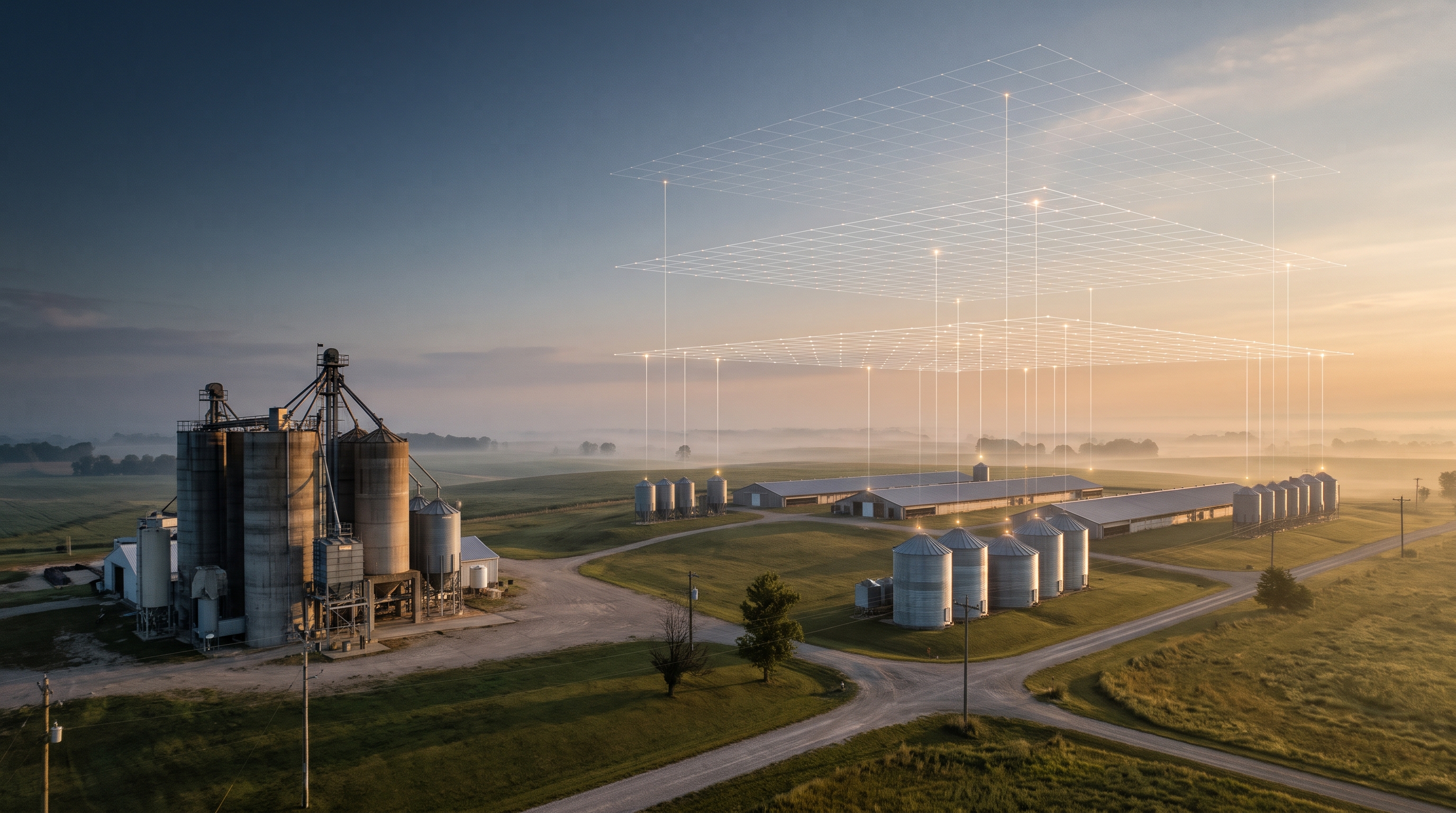
In BinSentry's architecture, artificial intelligence in the feed supply chain runs on three layers from bottom to top:
-
Sensors. Artificial intelligence in the sensor turns a dusty, uneven feed surface inside a bin or silo into a reliable inventory reading, day after day.
-
Data. Those readings accumulate into a labeled data layer of bin-level inventory, consumption and depletion, reconciled against deliveries and what the animals actually ate.
-
Models. Enterprise artificial intelligence platforms and planning models sit on top, turning that clean demand signal into forecasts, batch schedules and delivery plans.
Most software and analytical projects focus on the top layer. Models are widely available and improve every quarter. The missing piece in feed has been the bottom two layers. BinSentry is not an alternative to the enterprise artificial intelligence platform a protein company or feed mill already runs. It is the bottom two layers of the stack, sensors and data, connected to that platform: a feed data layer that starts compounding from the first sensor, with existing systems of record left untouched.
Climbing the maturity ladder one quarter at a time
Measuring the whole bin also changes how operations adopt artificial intelligence. Rather than waiting years for a full software replacement, mills and integrators can gain capability step by step while the customer's own feed data layer compounds from day one:
-
Estimated. Bin levels are guessed by ladder, knock or calendar. There is no verified history for any model to use.
-
AI-enabled. Every bin and mill silo is measured continuously, turning readings into bin-level inventory, consumption and depletion with no change to daily process. Labor hours, out-of-feed events and emergency loads drop in the first quarter.
-
Predictive. Models pre-trained on network history and tuned to the customer's own feed data layer forecast consumption, flag out-of-feed risk by farm and recommend replenishment windows to the mill, dispatch and farms. People make the decisions.
-
Directed. When the data earns it, the platform directs the replenishment loop inside guardrails the customer sets, and people manage exceptions.
Today it watches. Next it predicts. Then, when your data earns it, it directs. Every month of measured bin-level consumption strengthens the customer's data layer, which is why waiting to start measuring is the expensive option.
Proof at scale from mill to bin
BinSentry's artificial intelligence monitors the feed behind 2.65 billion birds and 41 million pigs a year, 22 million tons of feed a year through 70,000+ sensors from mill to barn, and unlocks vendor-managed inventory on the feed supply chain for the first time, with savings landing on the income statement inside the budget year and a modeled payback of under six months per monitored bin. Every day the network measures 239 billion surface points to produce 532,000 bin readings, and it monitors 1,845,000 tons of feed per month.
BinSentry builds artificial intelligence for the feed supply chain, from the sensor up, backed by 8 years of artificial intelligence models in production. BinSentry ProVision is the artificial intelligence platform for the feed supply chain, turning live bin-level inventory, consumption and depletion data into predictions and plans across mills, trucks and farms. It is in early access now and becomes commercially available in January 2027.
At a regional feed manufacturer using BinSentry, emergency (ASAP) orders fell from 4.82% of all orders to 1.74%, a 64% reduction, and out-of-feed events at monitored farms dropped by more than 52%. Those savings come from places a finance team can count: fewer out-of-feed events, fewer emergency loads and the premium freight they carry, fewer delivery miles, less leftover feed at ration transitions and close-out, mill inventory accuracy that tightens working capital, and labor that stops climbing bins.
The bottom line
Academic scoring tools like the National Animal Nutrition Program risk model, ingredient sensing at North Carolina State University and ration modeling at Oklahoma State University Extension show how fast feed-management artificial intelligence is advancing. Turning those insights into lower feed waste, fewer emergency deliveries and tighter working capital starts underneath the model, with measured bin-level inventory and depletion.
Boards want artificial intelligence progress. Feed is where protein companies can prove it in a quarter, and one conversation with BinSentry can define the first step.
Sources
-
Feed Strategy, "NANP develops AI tool to score feed value loss risk," November 16, 2026: https://www.feedstrategy.com/sustainability-in-feed-production/agriculture-technology/news/16541614/nanp-develops-ai-tool-to-score-feed-value-loss-risk
-
Food & Agribusiness, "Real-time ingredient analysis in feed production," November 16, 2026: https://www.foodagribusiness.world/feed/real-time-ingredient-analysis-in-feed-production
-
Feed Strategy, "Oklahoma State updates Cowculator, tests AI version for cattle diets," November 16, 2026: https://www.feedstrategy.com/animal-nutrition/beef-cattle/news/16541611/oklahoma-state-updates-cowculator-tests-ai-version-for-cattle-diets